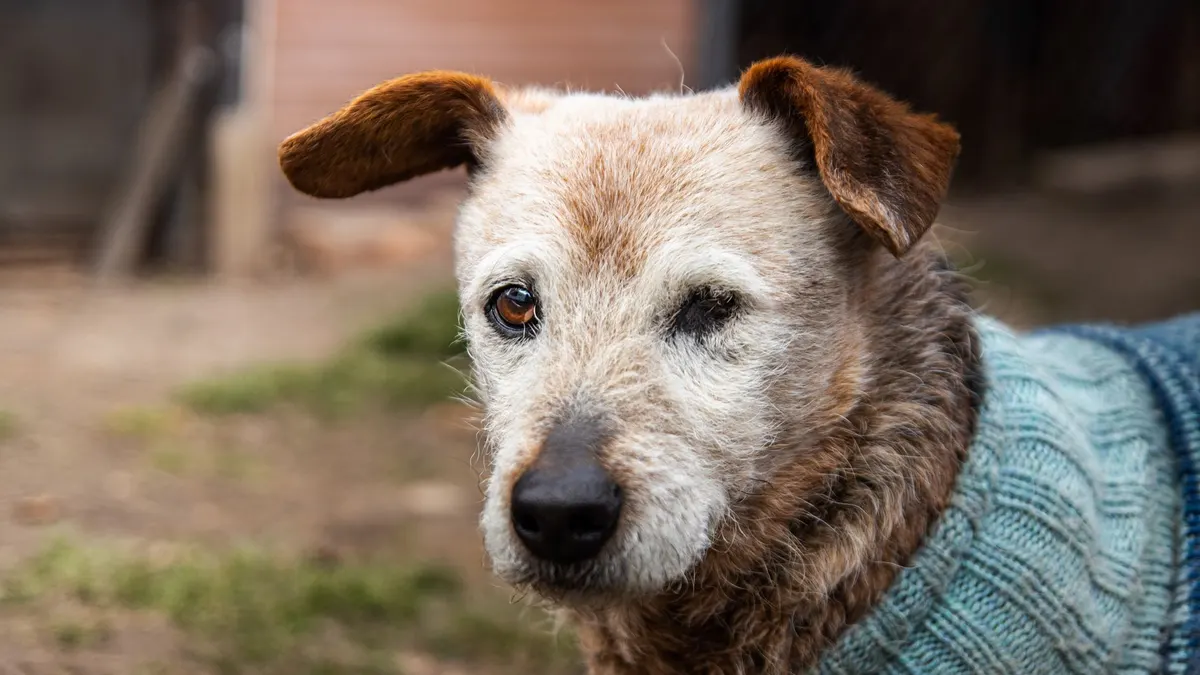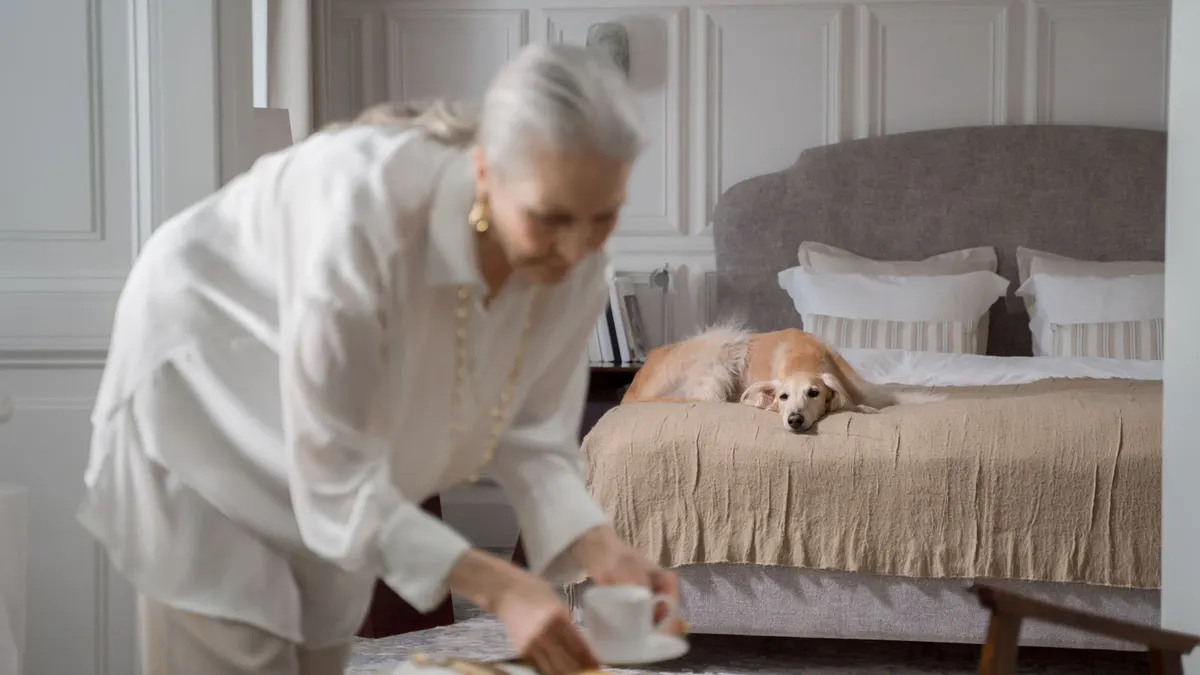
"Can stretching actually help my old dog's stiffness, or will I hurt him if I move the wrong leg?" That is the right question, and both halves deserve honest answers. Gentle stretching for senior dogs does help — older bodies lose range of motion the same way older people do, with tendons and ligaments shortening, joint capsules tightening, and muscles that hold one resting position for hours quietly forgetting what else they could do. A few minutes of slow, treat-guided movement most days keeps that range from disappearing. And no, you will not hurt him, provided you follow one rule: stretch only what is warm, only to mild resistance, and only while the dog agrees. It is not yoga, it is not prescribed physiotherapy, and it should never look like a workout.
What safe stretching looks like
A safe session means slow, treat-guided movements through a comfortable range — neck turns, gentle spinal curves, supported leg extensions — held roughly 10 to 20 seconds with no bouncing or forcing, for three to five total minutes, after a short warm-up. Stretch only to the first feel of resistance, never into pain, always support the limb you are moving, and stop if the dog pulls away, tenses, licks her lips, or looks worried. Get the vet's clearance first after surgery or injury; for serious or unstable conditions, a canine rehab professional should set the exact program.
Why flexibility matters for older dogs
A joint that is only ever used through a small part of its range loses the rest of that range over time. Senior dogs walk in shorter strides, lie down for long stretches, and rarely reach, twist, or play the way they once did, so the unused portion of each joint's range gradually tightens. When the dog then needs that range — stepping over a threshold, rising from a sit, squatting to toilet — the movement pulls at tight tissue and feels sore.
Stretching helps by gently lengthening muscle and connective tissue, encouraging blood flow, and reminding the nervous system that the full range is still safe and available. It pairs naturally with the short walks seniors still take: the walk warms the tissue, the stretching preserves the range. It also gives you a daily hands-on moment where a new swelling, asymmetry, or painful spot is likely to be noticed early.
When stretching is appropriate and when it is not
Gentle stretching suits otherwise healthy stiff seniors, dogs with managed osteoarthritis, and dogs in maintenance after rehabilitation. It is the wrong tool in the acute phase of an injury, around fresh surgical sites, over infected or swollen joints, during a pain flare, or for dogs with unstable joints or certain spinal conditions. If your dog has had a cruciate repair, spinal surgery, a fracture, or a recent sudden lameness, follow the specific protocol from the surgeon or rehab therapist rather than inventing one at home. When in doubt about which category your dog is in, one exam settles it — your vet may even clear you for a short list of movements and rule out the rest.
Set up the session
Preparation makes the session safe and pleasant for both of you.
- warm the dog first: a 5-minute slow walk, some indoor movement, or light massage until the muscles feel soft
- work on a non-slip surface where the dog stands confidently
- use small, soft, smelly treats the dog can lick without crunching
- keep your hands slow and calm; talk quietly throughout
- support the weight of any leg you move rather than letting it dangle
- time sessions for the dog's good hours, often mid-morning after the first walk
A five-move stretching routine
These movements follow the areas that tighten most. Treat the ranges as approximate; anatomy varies by breed and size. The active strengthening work — sit-to-stands, balance practice, weight shifting — is a different job with its own guide: strength moves that keep stretches working. This page stays with the passive, held stretches.
- Neck to shoulder and hip. With the dog standing, move a treat from the nose slowly toward the shoulder, hold 10 to 15 seconds at the comfortable end, then guide the nose back toward the hip. Repeat twice per side. This mobilizes the neck and upper spine.
- Chin to chest and forward. Guide the nose down between the front paws and hold briefly, then up and forward toward your face without forcing the head high. These help the dog reach food bowls and groom.
- Spinal side-bend. Standing beside the dog, draw the treat around toward the tail so the dog follows in a smooth curve through the whole spine. Hold, return, and repeat on the other side.
- Front-leg extension. Supporting under the elbow and wrist, draw a front leg gently forward into a comfortable reach, hold 10 to 15 seconds, and release. Repeat on the other leg. Avoid pulling upward or twisting.
- Hind-leg reach back. Supporting under the hock and stifle, draw a hind leg gently backward in line with the body, hold, and release. This opens the hip and stifle; go especially carefully here on arthritic dogs.
Finish with calm praise and let the dog walk a few steps to settle the movement.
How hard, how long, how often
The rule that prevents almost all stretching problems is simple: move the limb only until you feel the first soft resistance, then back off a fraction and hold. You should never see the dog's head turn, the muscles brace, or the breath change. Holds of 10 to 20 seconds, two or three repetitions per area, in sessions totaling three to five minutes, four to six days a week, are a sensible home program. More is not better. A daily five-minute session outperforms an occasional twenty-minute one. In practice, the marathon is exactly what produces the sore day that ends the routine.
Reading your dog's consent
Dogs give clear feedback if you watch for it. Willing leaning into the movement, relaxed ears, and taking the treat calmly mean continue. Lip licking, yawning, head turning, pulling the leg away, tensing the belly, whale-eye, growling, or a frozen posture mean stop that movement immediately and try a smaller range next time. Pain during or after stretching means the range or pressure was too much, not that the dog needs to get used to it.
Stretches that hurt
- stretching cold muscles before any warm-up
- bouncing or forcing beyond the comfortable end of range
- twisting joints, especially knees and elbows
- stretching to a fixed number of seconds regardless of response
- continuing through a pain flare or on days the dog is already stiff and sore
- using stretching as a substitute for prescribed pain medication or rehabilitation
When to call in professional help
Ask your veterinarian for referral to a canine rehabilitation practitioner when stiffness is significant, the dog has had orthopedic surgery, one leg is consistently worse, or home stretching produces no improvement or any distress. Rehab therapists use underwater treadmills, targeted therapeutic exercise, laser, and hands-on joint mobilization, and they can teach you a customized program with correct hand placement for your individual dog. Contact your vet promptly for sudden lameness, a swollen or hot joint, crying when moving, or a new reluctance to rise.
Stretching questions
Should I stretch my senior dog before or after a walk?
After, in most cases. The walk warms the tissue, and stretching warm muscles is both safer and more productive. Before the walk, stick to a minute or two of easy range-of-motion — a slow indoor wander and one or two gentle neck turns — and save the held stretches for afterward or for a quiet session at the dog's best hour.
How long before stretching shows results in an older dog?
Give a consistent daily routine two to four weeks before judging it. The first changes you will notice are usually attitude ones — a dog who stops hesitating at the start of the walk, or stretches voluntarily after a nap. If there is no change at all after a month, or any change for the worse, that is a conversation for your vet rather than a reason to stretch harder.
My dog yelps when I move her hind leg. Should I work through it?
No. Pain during a stretch means the range, the pressure, or the timing was wrong — not that the dog needs to get used to it. Stop that movement, skip stretching for a day or two, and if the yelp repeats when the same spot is touched, book an exam. Sudden pain on one limb, a hot joint, or crying when handled needs a diagnosis before any home routine resumes.
Five minutes, every day
Gentle stretching preserves the range of motion that sedentary senior life quietly steals, delivered as a few minutes of slow, treat-guided movement on warm muscles, stopped well short of pain. Done most days with careful attention to consent, it reduces stiffness, deepens your ability to notice physical changes, and gives an older dog a small, pleasant ritual. Keep it gentle, keep it regular, and let a professional guide the harder cases — that is the whole secret.