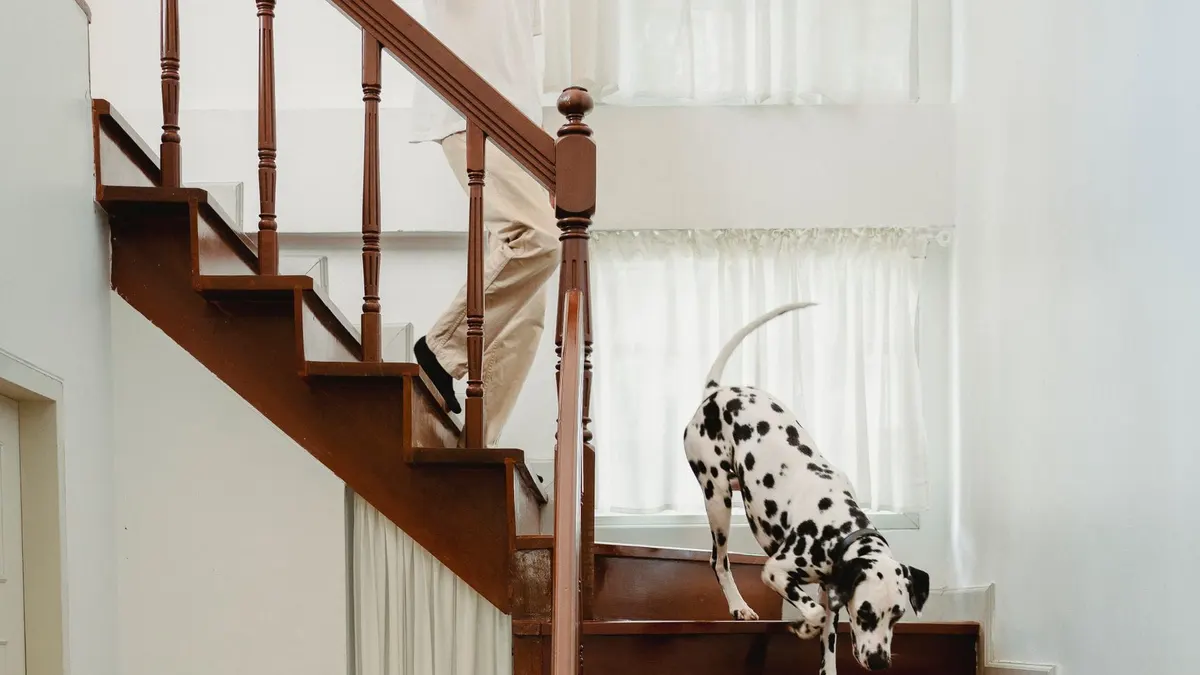
Stairs are one of the biggest daily challenges for many older dogs, especially when their footing, balance, or confidence is changing. A dog that once used the steps without hesitation may start slowing down, hesitating, or seeming unsure. In most homes the problem is not one single issue but a combination of slippery surfaces, poor visibility, and extra strain on aging joints.
This guide covers practical stair changes that help, when a ramp or single-floor setup makes more sense, and when stair struggles deserve a veterinary visit.
Quick answer
To make stairs safer for an older dog, improve traction on the steps, add clear lighting at the top and bottom, remove clutter, and reduce the need for risky stair use whenever possible. A secure, predictable route can make a big difference before the dog ever reaches the top or bottom step.
What makes stairs harder for senior dogs
Older dogs often need more room, gentler turns, and steadier footing. A staircase can become difficult when:
- the steps are slippery, glossy, or worn smooth
- there is poor lighting at the top, bottom, or along the run
- the dog cannot easily judge distance or footing
- the dog hesitates before climbing or descending
- the route feels crowded or unpredictable
- the dog has to carry food, water, or toys up and down
A dog that hesitates on stairs is usually not being difficult. The stairs have simply become harder than they used to be.
How to choose: traction, ramp, gate, or single-floor
The right approach depends on the dog's confidence, the staircase, and how often the dog actually needs to use the stairs.
📊Stair Safety Options for Older Dogs
| Option | Best for | Main benefit | Limitation |
|---|---|---|---|
| Stair treads / non-slip strips | Dogs that still use stairs but slip on smooth steps | Improves grip on existing stairs | Needs regular cleaning and re-taping |
| Better lighting | Dogs that hesitate in dim light or at night | Helps dog judge footing and distance | Requires an outlet or battery light |
| Baby gate at top and bottom | Dogs that should not use stairs unsupervised | Prevents risky solo attempts | Owner must open and close it consistently |
| Ramp for a short step | One or two steps at an entry, porch, or car | Gentler angle than the step itself | Not practical for full staircases |
| Move essentials to one floor | Dogs that struggle with the full climb | Removes most stair use from daily routine | Requires rearranging the home layout |
Click on any product to view full details and reviews
For baby gate options, see best baby gates for senior dogs. For ramp options on short step-ups, see best dog ramps for senior dogs.
Practical changes that help this week
1. Add secure traction to the steps
Use stair treads or non-slip strips that stay in place and are not too bulky. The goal is better grip without creating an edge that could catch a paw or cause a trip risk. Replace treads that have curled or worn smooth.
2. Increase visibility at the top and bottom
Older dogs often do better with a clear view of each step. A soft night light at the top and bottom of the stairs can reduce hesitation and help the dog judge the distance more confidently. See best night lights for senior dogs for options.
3. Keep the stairs clear
Remove toys, shoes, laundry, and clutter that could interfere with footing or cause awkward stepping. Clear steps help older dogs move more predictably.
4. Reduce unnecessary stair use
If the dog still uses stairs for food, bed, or other daily items, move the essentials to one level when possible. This reduces repeated strain without forcing the dog to "push through" a difficult setup.
5. Use a gate when needed
A gate is a good safety tool when the dog should not be using the stairs unattended, or when the route is too risky right now. It is a practical backup, not a replacement for a realistic long-term plan.
📋Stair Safety Checklist for Senior Dogs
0/7 completed- Add non-slip treads or strips to each step
- Place a night light at the top and bottom of the stairs
- Remove clutter, shoes, and toys from the steps
- Install a gate at the top and bottom if the dog should not use stairs alone
- Move food, water, and bed to one floor if the dog struggles with the full climb
- Use a ramp for short step-ups instead of asking the dog to jump
- Watch the dog use the stairs for one week and note any hesitation
Common mistakes to avoid
- Adding a ramp to a full staircase: Ramps work for short step-ups, not for full flights. A ramp on a staircase is usually too steep and unsafe.
- A gate at only one end: A top-of-stairs gate prevents falls going down, but a bottom-of-stairs gate also prevents risky attempts going up.
- Ignoring lighting: A dog that hesitates at the top of the stairs may be struggling to see, not to walk.
- Thick treads that curl: A curled tread edge catches paws and is more dangerous than a smooth step.
- Assuming the dog will "get used to it": If the dog hesitates or stumbles repeatedly, the setup is the problem, not the dog.
When a ramp or alternative setup makes sense
A dog ramp may help if the dog is struggling with a step-up or step-down, especially for a car, porch, or a short set of steps. A ramp only works well if it is stable, grippy, and set at a manageable angle. The right setup should make the transition easier, not more awkward.
A single-floor sleeping or feeding area often helps more than forcing daily routines through a stair-heavy route. See senior dog bedroom setup for more ideas on reducing daily effort.
When the problem may be more than the home setup
Home changes help a lot, but they do not replace a veterinary evaluation when a dog's mobility is clearly changing. Stair struggles can be the first visible sign of arthritis, weakness, neurological changes, or pain.
When to call your veterinarian
Monitor at home
- the dog uses stairs more slowly but still confidently
- hesitation only at the top or bottom, no stumbling or falling
- no other changes in energy, appetite, or willingness to walk
Schedule a veterinary visit
- the dog starts hesitating mid-stair or stumbles on a regular basis
- the dog avoids stairs it used to take easily
- stiffness after using stairs that lasts longer than a few minutes
- new reluctance to walk, jump, or use the car
Seek prompt veterinary care
- sudden inability to stand or walk after using stairs
- a fall down the stairs with limping, pain, or collapse
- sudden weakness in the back legs
- obvious pain, vocalization, or distress
A short phone video of the dog using the stairs can help the veterinarian see the pattern even if it does not happen during the exam.
Related guides
- Best Baby Gates for Senior Dogs
- Best Dog Ramps for Senior Dogs
- Best Night Lights for Senior Dogs
- Senior Dog Bedroom Setup
- Senior Dog Home Safety Checklist
- How to Help an Older Dog Get Into a Car
- How to Stop an Older Dog From Falling Down Stairs
FAQ
What is the easiest first change for stairs?
Improve traction and lighting first. Those two changes usually provide the largest benefit for older dogs because they reduce slipping and uncertainty.
Should I use a ramp or a gate?
It depends on the dog and the layout. A gate can prevent risky solo access, while a ramp may be a better long-term option if the dog has to manage a short step or entry frequently. For full staircases, ramps are usually impractical.
How do I know if the dog is struggling because of stairs or because of pain?
If the dog hesitates, falls, or seems uncomfortable in a new or worsening way, it may be worth discussing with a veterinarian. Home changes help, but they do not rule out a broader mobility issue.
Can I move resources to one floor instead of changing the stairs?
Yes. This is often a very effective option. If the dog's bed, bowls, or favorite resting area are upstairs and the dog is struggling to navigate the stairs, moving a few essentials may reduce daily risk significantly.
Are dog ramps safer than stairs for older dogs?
For short step-ups (one or two steps), a stable ramp can be easier on the joints than the step itself. For full staircases, ramps are usually too steep and unsafe. Traction, lighting, and a gate are usually better options for full stairs.