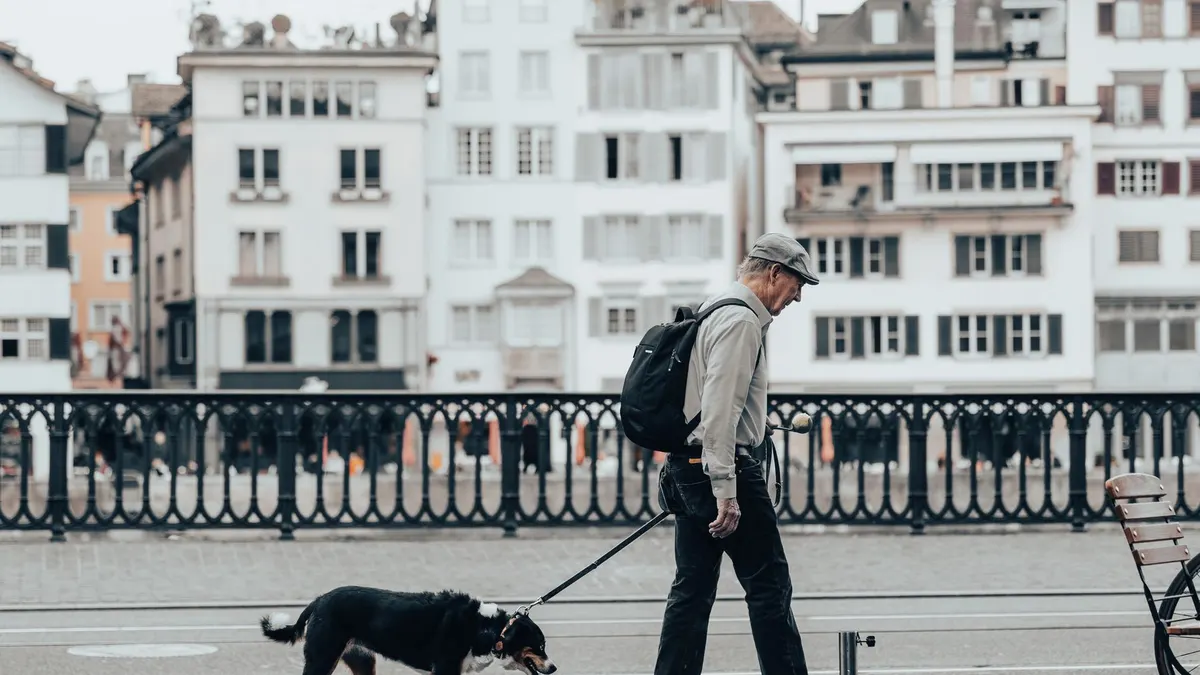
The most useful thing in senior dog care is not a ramp, a brace, or an expensive joint chew. It is a short written list, done on purpose, every day. Old dogs decline slowly, and slow change is invisible to the person who sees the dog every morning. A checklist replaces "he seems a bit off" with "his water doubled on the 3rd and his appetite dropped Tuesday." One of those gets a shrug. The other gets treated.
The list, in its shortest honest form
Five daily anchors — fresh water, measured meals, medication on time, one gentle movement break, and a two-minute body scan — plus a weekly pass for weight, nails, ears, and teeth. Total active time is about ten minutes beyond feeding and walking. Anything longer gets skipped, and a skipped checklist protects nobody.
Each item is a fixed question you can answer the same way tomorrow, which is the whole trick. It turns a feeling into a dated, comparable fact. Organize the list by scenes, not by body parts, because scenes are when you actually touch the dog. Body-part lists get forgotten at 9 p.m.; scene lists ride on habits you already have.
Scene 1: the first ten minutes after wake-up
Morning is your baseline reading. Everything you observe on rested, cold legs beats anything the afternoon will show.
| Do | Don't |
|---|---|
| Refill water and glance at how much is gone overnight | Skip the thirst check — doubled intake is an early alarm for kidney disease, diabetes, and Cushing's |
| Watch the rise and the first ten steps | Rush him up stairs while joints are cold |
| Give morning medication exactly as the label directs | Hide a fasted drug inside the whole breakfast |
| Put down a measured portion and watch interest and speed | Free-feed from a full bowl and hope |
| Note the first stool: formed, soft, straining, or missed | Wave off a recurring soft stool as nothing |
A dog who hesitates three mornings running has told you something about his hips. Write it down before you talk yourself out of it. These five glances take under three minutes total. Their value compounds: the dog who merely "seemed off" in March has a dated record by June, and dated records are what turn a managed diagnosis into an affordable one.
Scene 2: the middle of the day
Midday is maintenance, not medicine. Low stakes, small moves, comfort checks. The goal is not data collection but keeping the body comfortable between the morning reading and the evening one. Most of what goes wrong midday is stillness: a dog who has not moved, drunk, or shifted position in six hours.
| Do | Don't |
|---|---|
| Offer a ten to fifteen minute sniffy outing or yard trip | Push through a limp to keep the schedule |
| Refresh water near where he actually rests | Move bowls and beds to new rooms mid-routine |
| Encourage a heavy sleeper to shift position every couple of hours | Ignore bare bony points — pressure sores form on immobile seniors |
| Give the midday dose if the prescription is twice-daily | Double up after a forgotten dose without asking the clinic |
| Check the resting spot: padded, draft-free, easy entry | Let him settle on hard tile all afternoon |
Honestly, the repositioning habit is the one most people skip and most regret. A stiff fifteen-year-old cannot always be bothered to move, and skin over hips and elbows pays for it.
Scene 3: dinner through lights-out
Evening is when you collect the day. Build the scan into petting so the dog never learns that hands mean an exam.
| Do | Don't |
|---|---|
| Feed dinner at the fixed time, evening meds as directed | Chase a reluctant eater around the kitchen with the bowl |
| Run slow hands over ears, neck, spine, ribs, belly, legs, toes | Turn the two-minute scan into a tense full-body inspection |
| Glance at nail length and the skin between the pads | Clip toward the quick to finish early |
| Take the last potty trip early, unhurried, same route | Restrict water to survive the night — never do this without vet instruction |
| Write the sixty-second note: appetite, water, energy, stool, mobility, oddities | Trust your memory to hold any of it until tomorrow |
The scan earns its keep. Lumps the size of an almond, found during couch time, are a different conversation than lumps found by accident at the size of a walnut. Pick the moment when the dog is already relaxed — evening couch time beats a scheduled handling session. Two slow minutes then double as bonding, and a dog who tolerates the scan is a dog whose scan you will actually finish.
Scene 4: the weekly sweep
Pick a fixed day. Sunday evening works for most households because the vet clinic answers the phone on Monday.
| Do | Don't |
|---|---|
| Weigh on the same scale, same time — hold small dogs and subtract yourself | Weigh daily; the fluctuation is noise, the trend is data |
| Check nails, ears (smell and look), and lift the lips for gums | Dig into an inflamed ear with home remedies instead of booking a visit |
| Part the coat to the skin for flakes, growths, and thinning | Assume coat change is just seasonal |
| Wash bedding hot and dry it fully | Let damp bedding sit against thin senior skin |
| Read the week's notes in one sitting and check refill dates | Wait for the next appointment to remember what Tuesday was like |
A drift of a few percent in body weight over a month, in either direction, belongs in front of your vet. Unexplained weight loss is one of the earliest, most honest signals an old dog produces. And while you are down there with the clippers, notice how he holds each paw: one foot consistently tucked off the ground is often the first gait complaint you will ever get.
Keep it short or lose it
The failure mode is not forgetting items; it is bloating the list until you abandon it. Trim anything three weeks in a row that never produces data — every item should earn its place by surfacing information at least once a month. Three rules keep the habit alive:
- Never change food, supplements, or medication timing mid-checklist. Consistency is what makes your observations comparable. Ask the vet first, then adjust the list to match.
- Act on patterns, not single days. One skipped breakfast is a dog being a dog. Three is a finding.
- Some things skip the list entirely. Refusal to eat past 24 hours, repeated vomiting, a swollen or painful belly, collapse, labored breathing, a seizure, a sudden thirst surge with accidents, or a dog who looks lost in his own home are same-day phone calls, not tonight's bullet point.
The first old dog I shared care duties with taught me the double-dose lesson the hard way: two people, one thyroid tablet each, both certain the other had missed it. A shared checklist taped where the food is scooped ended that argument permanently.
Three questions about the checklist habit
What should be on a senior dog daily care checklist?
Fresh water, a measured meal, medication on time, one gentle movement break, a two-minute body scan, and a sixty-second written note on appetite, energy, stool, and mobility. Weekly adds weight, nails, ears, teeth, and bedding.
How often should I weigh my senior dog?
Once a week, on the same scale and at roughly the same time of day. A drift of a few percent either way across a month deserves a call to your vet; day-to-day fluctuation is just noise.
How do I know if my senior dog's routine needs to change?
Watch trends, not single days. Three consecutive dips in appetite, new stiffness after rest, fresh house accidents, or broken sleep mean the routine needs editing — and the vet needs the note.
Print it, post it, start tonight
Copy the four scene tables onto one page. Tape it inside the food cabinet, not on a wall you walk past. Tonight, do only two things from it: the sixty-second note and the slow-petting scan. Once those stick — usually a week — add the morning water glance and the weekly Sunday sweep. If the whole thing starts taking more than ten minutes, cut an item instead of cutting a day. And if the paper version is living in a drawer by Friday, move the whole list into a shared note on everyone's phones; the best checklist format is the one that survives your busiest week.