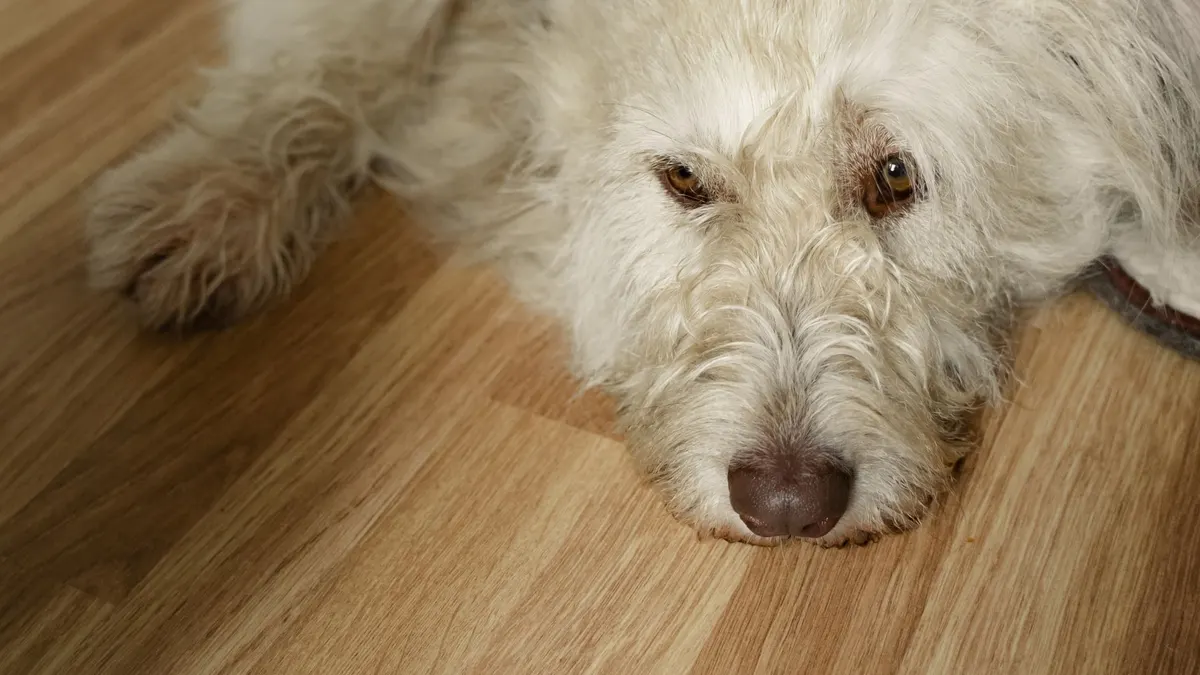
If your senior dog is slipping on hardwood or tile floors, the cause is usually a combination of the slick surface and the dog's reduced stability, strength, or confidence. Most older dogs do better once traction is added in the few routes they use most often — by the bed, food, water, and door — rather than trying to fix every floor in the house.
This guide covers why older dogs slip, where to start, what to avoid, and when slipping is a sign of something more than the floor.
Quick answer
Older dogs slip on hardwood because the surface offers almost no grip, and the dog is often less steady, slower to correct a stumble, or hesitant at turns. The fastest fix is to add flat, secure traction in the dog's main routes — bed to food, food to door, and any hallway or kitchen crossing — before buying paw grips, boots, or ramps.
Why old dogs slip more on smooth floors
Several issues add up on hardwood and tile:
- reduced muscle strength and balance
- stiffness or joint discomfort when moving or turning
- slower changes in direction and hesitation at turns
- less confidence when a surface feels slick or unpredictable
- longer nails or paw hair reducing pad-to-floor contact
- reduced proprioception (the body's sense of where the limbs are)
A dog that used to cross the room without thinking may now hesitate, splay a foot, or "paddle" with the back legs to regain balance. Even a small slip can make an older dog feel less confident on the same route the next time.
Where to start: focus on the dog's real routes
Do not try to fix every floor in the house. Start with the routes the dog actually uses every day:
- the path from bed to food and water
- hallways and doorways
- the area by the couch or favorite resting spot
- the route to the yard, porch, or car
These are the spots where a small traction improvement makes the biggest daily difference. A rug in a guest room will not help your dog as much as a runner in the kitchen hallway.
Traction options that work in real homes
Most slipping can be reduced with one of four approaches. The right choice depends on the dog, the home, and how willing you are to maintain the setup.
📊Traction Solutions for Senior Dogs on Hardwood Floors
| Solution | Best for | Main benefit | Limitation |
|---|---|---|---|
| Non-slip runner or rug | High-use routes (hall, kitchen, bed path) | Stable, flat grip the dog can trust | Needs to lie flat and stay secured |
| Paw grips / toe grips | Small traction issues, travel, dogs that resist rugs | Portable, works on any floor | Some dogs need time to adapt; falls off over time |
| Indoor dog boots | Dogs that slip on multiple surfaces, paw injuries | Protects paws and adds grip | Can be hard to fit; many dogs dislike them |
| Paw balm / wax | Mild slipping, dry or cracked paw pads | Improves pad condition, slight grip | Grip effect is limited and temporary |
Click on any product to view full details and reviews
For most homes, the first step is a flat, secured runner on the dog's main route. See best non-slip mats for senior dogs for specific options and best rugs for dogs that slip on hardwood floors for runner-style choices.
Step-by-step: make hardwood floors safer this week
1. Walk the dog's main route at the dog's pace
Follow the path your dog uses from bed to food, food to door, and to the favorite resting spot. Note where the dog slows, hesitates, or splay a foot. Those are the priority spots.
2. Add a flat, secured runner on each priority route
Choose a runner with a strong non-slip backing. Tape the edges down if needed so they do not curl. The goal is a surface the dog can trust without thinking about it.
3. Check paws and nails
Long nails change how the paw touches the floor and reduce pad grip. Trimmed nails and short paw hair make a real difference on smooth floors. See senior dog grooming: a simple routine for a low-stress approach.
4. Remove clutter that forces awkward turns
Toys, laundry, shoes, and furniture that the dog must weave around make smooth floors harder. A clear, predictable path reduces the number of times the dog has to slow down or change direction.
5. Recheck after a week
Watch how the dog moves on the same route. If slipping stops, you are done. If the dog still slips in the same spot, add traction or move on to paw grips.
📋Hardwood Floor Traction Checklist
0/7 completed- Identify the dog's top three daily routes
- Add a flat, secured runner on each priority route
- Tape down rug edges that curl
- Trim long nails and shorten paw hair
- Clear clutter from the dog's main path
- Add a night light if the dog hesitates in the dark
- Recheck the same routes after one week
Common mistakes to avoid
- Covering every floor: Wastes money and creates tripping edges. Fix the routes the dog actually uses.
- Loose or curling rugs: A rug that moves underfoot is more dangerous than the slick floor itself.
- Thick mats: A high pile or thick edge catches paws and makes turns harder.
- Ignoring nail length: Even the best rug will not help if long nails are lifting the paw off the floor.
- Assuming the dog will "get used to it": If a dog hesitates or slips repeatedly, the setup is the problem, not the dog.
- Adding paw grips before fixing routes: Paw grips are a useful second step, but they do not replace a stable walking surface.
When slipping is more than a floor problem
Home changes help with traction, but they do not fix weakness, pain, or balance issues. If your dog is slipping more often even after improving the routes, the cause may be medical rather than environmental.
Conditions that can contribute to slipping include arthritis, muscle loss, neurological changes, vestibular issues, or pain in the hips, knees, or back. These are not diagnoses to make at home — but they are reasons to talk with a veterinarian.
When to call your veterinarian
Monitor at home
- slipping only on smooth floors, with no change in energy, appetite, or willingness to walk
- stiffness that improves after a few minutes of movement
- slipping that improves once traction is added
Schedule a veterinary visit
- slipping that continues after traction improvements
- new hesitation before standing or walking
- stiffness that lasts longer than a few minutes after rest
- reduced willingness to walk, jump, or use stairs
Seek prompt veterinary care
- sudden inability to stand or walk
- dragging or knuckling the back paws
- sudden weakness in the back legs
- obvious pain, vocalization, or collapse
- head tilt, circling, or loss of balance
A short phone video of the dog walking, turning, and standing up can help the veterinarian see the pattern even if it does not happen during the exam.
Related guides
- Best Non-Slip Mats for Senior Dogs
- Best Rugs for Dogs That Slip on Hardwood Floors
- How to Make Hardwood Floors Safer for Dogs
- Senior Dog Home Safety Checklist
- Why Are My Senior Dog's Back Legs Weak?
- How to Help a Senior Dog Walk Better
FAQ
Why is my older dog slipping on hardwood if the dog is otherwise normal?
Because the problem is rarely fear or stubbornness. It is usually the combination of a slick surface and a body that is less stable than it once was, especially when the dog is turning, slowing down, or moving with less confidence.
Are rugs enough to stop my senior dog from slipping?
Often yes, but only if they lie flat, stay secured, and run the full length of the dog's main route. A loose or curling rug can become a bigger hazard than the original floor.
Where should I start with anti-slip improvements?
Start with the dog's highest-use path — bed, food and water, door, and favorite resting spot. One or two well-placed runners can make a bigger difference than five small mats scattered around.
Should I use paw grips, toe grips, or boots indoors?
They can help, especially for travel or dogs that slip on multiple surfaces. But most dogs do better with a stable runner on the main route first. Paw grips and boots are usually a second step, not the first fix.
When should slipping become a veterinary concern?
If slipping is new, worsening, paired with limping, weakness, hesitation when standing, dragging the back paws, or pain, schedule a veterinary evaluation. Sudden inability to stand or walk should be seen promptly.
Do I need to fix every floor in the house?
No. Focus on the routes the dog actually uses. A clear, grippy path from bed to food to door is usually enough to make daily movement feel safe again.